Critical Business Impact
Commercial refrigeration systems in Adelaide handle inventory worth thousands of dollars daily. A single equipment failure costs businesses between $3,200 and $8,500 in lost stock, emergency repairs, and operational downtime. Preventative maintenance reduces system failures by 87% and extends equipment lifespan by 40%. Most Adelaide businesses operate refrigeration units 24/7, creating compounding mechanical stress that accelerates component degradation without scheduled intervention.
Without Scheduled Maintenance:
- Compressor failure occurs 3.2 times faster
- Energy costs increase 25–40% within 18 months
- Temperature fluctuations breach food safety compliance
- Emergency service calls cost 340% more than preventative visits
The decision to implement structured maintenance determines whether refrigeration systems remain operational assets or become financial liabilities. Adelaide’s climate creates specific operational challenges—summer temperatures exceeding 40°C force refrigeration units to work significantly harder, accelerating wear on condensers, evaporators, and compressor components.
Reactive maintenance strategies fail commercially because they wait for equipment failure before intervention. This approach guarantees maximum downtime, maximum repair costs, and maximum inventory loss. Businesses operating without preventative schedules experience system failures during peak trading periods when replacement parts are difficult to source and emergency labour rates apply.
What is Commercial Refrigeration Maintenance in Adelaide?
Commercial refrigeration maintenance is a scheduled technical service that inspects, tests, cleans, and adjusts refrigeration equipment to maintain optimal performance. Adelaide-specific maintenance addresses high ambient temperatures, dust accumulation from urban and industrial environments, and operational stress from continuous 24/7 operation across hospitality, retail, and food processing sectors.
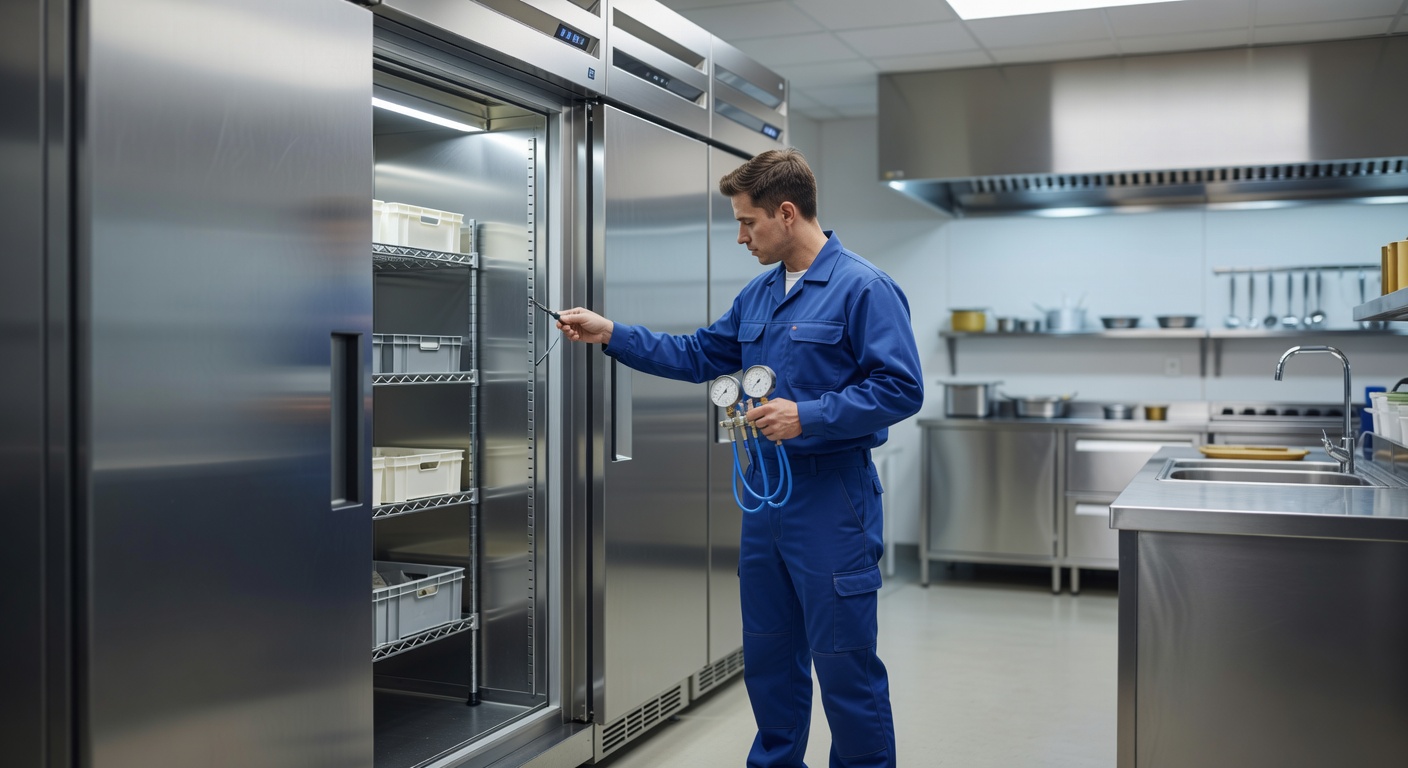
Maintenance services differ fundamentally from repair services. Maintenance prevents failures through systematic component inspection before mechanical degradation causes operational disruption. A qualified refrigeration mechanic examines refrigerant levels, electrical connections, compressor operation, condenser coil cleanliness, door seal integrity, and thermostat calibration during each scheduled visit.
Adelaide businesses require maintenance frequencies based on equipment type and operational intensity. Walk-in cool rooms operating in commercial kitchens need quarterly maintenance due to high door access frequency and temperature cycling. Display fridges in retail environments require bi-annual service focusing on condenser cleaning and refrigerant pressure verification. Industrial cold storage facilities demand monthly inspections because equipment failures impact entire supply chains and breach food safety compliance standards.
Preventative Maintenance Approach
- Scheduled inspections every 60–90 days
- Component replacement before failure
- Predictable operational budgets
- 87% reduction in emergency failures
- Equipment lifespan extended 8–12 years
Reactive Repair Approach
- No scheduled service until breakdown occurs
- Emergency callout rates 340% higher
- Unpredictable repair costs and timing
- Inventory loss during equipment downtime
- Equipment replacement needed after 4–6 years
The technical scope of commercial refrigeration maintenance extends beyond basic cleaning. Refrigerant pressure testing identifies slow leaks that reduce cooling efficiency by 15–30% before becoming apparent through temperature monitoring. Electrical connection inspections prevent compressor failures caused by voltage irregularities—a common issue in Adelaide’s older commercial buildings where electrical infrastructure hasn’t been upgraded to match modern refrigeration loads.
Condenser coil cleaning directly impacts operational costs. Dust, grease, and airborne particles accumulate on condenser fins, reducing heat dissipation efficiency. This forces compressors to run longer cycles to achieve target temperatures, increasing electricity consumption by 22–38%. Adelaide’s urban environment accelerates condenser contamination—businesses located near construction sites or industrial areas require more frequent cleaning intervals.
Why Commercial Refrigeration Maintenance Matters for Adelaide Businesses
Scheduled maintenance protects three critical business functions: operational continuity, regulatory compliance, and financial performance. Adelaide’s food safety regulations mandate temperature control documentation, making equipment reliability a legal requirement. Maintenance prevents the catastrophic scenario where health inspectors identify temperature breaches during unannounced audits, resulting in immediate closure orders and reputational damage.
Energy costs represent 60–70% of total refrigeration operating expenses. Well-maintained systems consume 25–40% less electricity than neglected equipment. For an Adelaide restaurant operating three walk-in cool rooms, this efficiency difference translates to $4,800–$7,200 annual savings. These savings compound over equipment lifespan—a properly maintained commercial fridge delivers 12–15 years of service compared to 5–7 years for unmaintained units.
Maintenance protects inventory value by preventing temperature fluctuations. A malfunctioning thermostat or failing compressor creates temperature variations that compromise food safety without triggering immediate alarm systems. Restaurants discover the problem only when stock spoilage becomes visible—by which point thousands of dollars in inventory must be discarded. Preventative maintenance identifies thermostat drift before it impacts stored products.
Business Continuity Risk
Equipment failure during peak trading periods creates cascading operational impacts. Adelaide hospitality businesses experience highest demand during summer months—precisely when refrigeration systems face maximum stress. A Saturday night compressor failure forces restaurants to turn away customers, cancel bookings, and discard prepared inventory.
Failure During Peak Trading:
- Lost revenue: $3,000–$8,000 per day
- Emergency repair premium: 340% standard rates
- Staff idle time while equipment offline
- Customer trust damage from cancelled bookings
- Social media reputation impact
Insurance implications extend beyond immediate repair costs. Many commercial insurance policies include exclusions for equipment failures resulting from inadequate maintenance. Businesses cannot claim inventory loss if service records don’t demonstrate regular professional maintenance. This transforms a $5,000 stock loss into an uninsured business expense that directly impacts profitability.
Adelaide’s competitive hospitality and retail markets make operational efficiency a differentiator. Businesses spending 40% more on energy costs or experiencing frequent equipment downtime cannot compete on pricing or service reliability. Maintenance transforms refrigeration from a cost centre into a competitive advantage by ensuring consistent performance and predictable operating expenses. If you need professional guidance, contact our team to establish a maintenance schedule.
Practical Implementation Strategies for Adelaide Commercial Refrigeration
Effective maintenance programs require three foundational elements: scheduled service intervals aligned with equipment type, qualified technician access with Adelaide-specific expertise, and comprehensive service documentation for compliance verification. Implementation begins with equipment audit and risk assessment, then establishes frequency protocols based on operational intensity and ambient conditions.
High-Intensity Equipment
Restaurant walk-in cool rooms, bar refrigeration, commercial kitchens: Quarterly maintenance (every 90 days). High door access frequency and temperature cycling accelerate component wear.
Medium-Intensity Equipment
Retail display fridges, cafe refrigeration, small commercial kitchens: Bi-annual maintenance (every 180 days). Moderate operational stress with predictable usage patterns.
Critical Infrastructure
Industrial cold storage, pharmaceutical refrigeration, food processing facilities: Monthly maintenance. Equipment failure impacts entire supply chains and triggers regulatory breaches.
Seasonal Preparation
All equipment types: Pre-summer inspection (October–November). Adelaide’s extreme heat requires system verification before peak demand periods to prevent mid-summer failures.
Service contracts with Adelaide-based providers deliver superior outcomes compared to ad-hoc maintenance arrangements. Contracted technicians understand your specific equipment configuration, maintain service history records, and prioritise scheduled clients during emergency situations. Contract pricing eliminates the 340% emergency callout premium that applies to unscheduled service requests.
Documentation requirements extend beyond basic service records. Food safety compliance audits require timestamped temperature logs demonstrating continuous cold chain integrity. Modern maintenance programs integrate digital monitoring systems that record temperature data, alert managers to deviations, and provide auditable compliance evidence. Adelaide health inspectors specifically request these records during unannounced inspections.
Maintenance Scheduling Best Practice
Schedule maintenance during low-trading periods to minimise operational disruption. Monday and Tuesday mornings work best for hospitality businesses. Retail operations benefit from pre-opening maintenance visits. Critical infrastructure requires after-hours service to avoid production interruptions. Always maintain backup refrigeration capacity during scheduled maintenance windows.
Component replacement protocols determine long-term maintenance costs. Proactive replacement of wear items—door seals, fan motors, thermostats—during scheduled maintenance prevents emergency failures that require urgent parts procurement at premium pricing. Adelaide’s distance from major refrigeration supply centres means emergency parts often require overnight freight, adding $200–$400 to repair costs.
Staff training complements professional maintenance by identifying early warning signs between scheduled services. Train kitchen staff to recognise unusual compressor noise, door seal degradation, temperature fluctuations, and condensation patterns. Early detection allows scheduled intervention before minor issues escalate into equipment failures. Simple daily checks—verifying temperature readings, inspecting door seals, listening for abnormal sounds—prevent 30% of common refrigeration failures.
Professional Maintenance Service
- Refrigerant pressure testing and recharging
- Compressor performance diagnostics
- Condenser and evaporator coil cleaning
- Electrical connection inspection and testing
- Thermostat calibration verification
- Door seal integrity assessment
Daily Staff Monitoring
- Temperature reading verification
- Visual door seal inspection
- Unusual noise identification
- Condensation pattern monitoring
- Immediate reporting of anomalies
- Basic external cleaning protocols
Commercial Value, ROI, and Operational Impact
Preventative maintenance delivers measurable ROI through three financial mechanisms: extended equipment lifespan reducing capital replacement costs, lower energy consumption decreasing operational expenses, and eliminated emergency repairs preventing unpredictable cost spikes. Adelaide businesses implementing structured maintenance programs achieve payback periods of 8–14 months through combined savings.
Consider a typical Adelaide restaurant operating three commercial refrigeration units with combined replacement value of $45,000. Without maintenance, equipment lifespan averages 5–7 years, requiring capital replacement every 6 years at current pricing. Maintenance programs extend lifespan to 12–15 years, deferring replacement costs and reducing annualised capital expenses from $7,500 to $3,000—a $4,500 annual saving.
Energy efficiency improvements deliver immediate cash flow benefits. A well-maintained commercial fridge consuming 8,500 kWh annually costs approximately $2,380 in electricity at Adelaide’s commercial rates. Equipment degradation increases consumption by 25–40%, adding $595–$952 annually per unit. For businesses operating multiple refrigeration systems, these efficiency losses compound into substantial operational costs.
Cost Comparison: 5-Year Total Ownership
Financial analysis comparing maintenance program investment against reactive repair approach for a typical Adelaide commercial kitchen operating three refrigeration units over five years.
Preventative Maintenance Program:
- Annual maintenance contracts: $1,800/year × 5 years = $9,000
- Scheduled component replacements: $2,400 total
- Energy costs (efficient operation): $11,900/year × 5 years = $59,500
- Emergency repairs: $600 (minor issues only)
- 5-Year Total: $71,500
Reactive Repair Approach:
- No scheduled maintenance: $0
- Emergency repairs (3–5 failures): $15,000–$22,000
- Energy costs (degraded efficiency): $15,900/year × 5 years = $79,500
- Inventory loss during failures: $8,000
- 5-Year Total: $102,500–$109,500
Net Savings with Maintenance Program: $31,000–$38,000 over 5 years
Risk mitigation value often exceeds direct cost savings. A single refrigeration failure during peak trading causes immediate revenue loss, but also creates downstream impacts—cancelled customer bookings damage reputation, social media complaints affect future business, and staff idle time wastes payroll expenses. These indirect costs rarely appear in maintenance ROI calculations but significantly impact business profitability.
Compliance value protects business licenses and operating permits. Adelaide food safety regulations enforce strict temperature control requirements. Health inspection failures result in closure orders that remain publicly searchable, permanently damaging business reputation. Maintenance programs that include temperature logging and documentation demonstrate due diligence, protecting against regulatory action and providing legal defence if food safety incidents occur.
Insurance premium reductions provide additional financial benefits. Commercial insurers offer premium discounts for businesses maintaining comprehensive service records. More importantly, maintenance documentation prevents claim denials when equipment failures cause inventory loss. The difference between an approved $12,000 insurance claim and a denied claim represents immediate bottom-line impact. To explore maintenance programs designed for Adelaide businesses, book a consultation with our commercial refrigeration specialists.
Competitive Advantage Through Operational Efficiency
Adelaide’s hospitality and retail markets operate on thin profit margins where operational efficiency creates competitive differentiation. Businesses spending 40% less on refrigeration-related costs can offer better pricing, invest more in marketing, or maintain higher quality inventory. Reliability advantages allow businesses to accept large catering contracts and commit to supply agreements without equipment failure risk.
Risks, Limitations, and Common Implementation Mistakes
Maintenance programs fail when businesses select inadequate service frequencies, engage unqualified technicians, or neglect proper documentation. Adelaide’s extreme climate conditions demand more rigorous maintenance protocols than temperate regions—service schedules designed for Melbourne or Sydney environments underperform in Adelaide’s heat. Understanding these limitations prevents maintenance programs from becoming cost centres without delivering promised benefits.
The most common implementation mistake is selecting maintenance frequency based solely on cost rather than operational risk. Businesses attempting to reduce expenses by extending service intervals from quarterly to annual maintenance eliminate the preventative benefits entirely. Equipment degradation accelerates during the extended interval, causing the precise failures maintenance was designed to prevent.
Technician qualification directly determines maintenance effectiveness. General HVAC technicians lack specialised refrigeration expertise required for commercial systems. Adelaide’s commercial refrigeration regulations require licensed technicians holding specific refrigerant handling certifications. Using unqualified service providers voids equipment warranties, creates compliance risks, and often causes more damage than benefit through incorrect adjustments or improper refrigerant handling.
Critical Implementation Failures
These mistakes transform maintenance programs from protective investments into ineffective expenses that fail to prevent equipment failures or deliver promised ROI.
Five Common Failure Points:
- Insufficient service frequency for operational intensity
- Engaging lowest-cost providers without qualification verification
- No systematic documentation or compliance record-keeping
- Ignoring manufacturer-specific maintenance requirements
- Failing to schedule pre-summer preventative inspections
Documentation failures create compliance vulnerabilities even when physical maintenance occurs correctly. Adelaide health inspectors require timestamped service records demonstrating continuous maintenance compliance. Verbal service agreements or informal maintenance arrangements provide no audit defence. Digital service management systems that automatically generate compliance reports and store service history protect businesses during regulatory inspections.
Equipment age limitations affect maintenance effectiveness. Systems exceeding 15–20 years require increasingly frequent repairs regardless of maintenance quality. Continuing maintenance on obsolete equipment becomes financially inefficient when annual service costs approach 40–50% of replacement value. Strategic equipment replacement decisions must balance maintenance investment against long-term capital planning.
Refrigerant regulation changes create unexpected compliance costs. Older refrigeration systems using R22 refrigerant face supply restrictions and premium pricing as environmental regulations phase out ozone-depleting substances. Maintenance programs for legacy equipment must include refrigerant conversion planning or accelerated replacement timelines to avoid situations where refrigerant unavailability renders otherwise functional equipment inoperable.
Frequently Asked Questions
How often should commercial refrigeration equipment be serviced in Adelaide?
Service frequency depends on equipment type, operational intensity, and environmental conditions. High-intensity equipment like restaurant walk-in cool rooms requires quarterly maintenance (every 90 days) due to continuous operation, frequent door access, and temperature cycling stress. Medium-intensity equipment such as retail display fridges needs bi-annual service (every 180 days). Critical infrastructure including industrial cold storage demands monthly inspections because equipment failure impacts entire supply chains.
Adelaide’s extreme summer temperatures create additional maintenance requirements. All equipment types benefit from pre-summer inspections conducted in October or November before peak heat periods begin. These inspections verify system capacity, clean condenser coils, check refrigerant levels, and identify potential failure points before equipment faces maximum operational stress. Businesses in dusty or industrial locations require more frequent condenser cleaning—potentially monthly during summer—because airborne particles accumulate faster and reduce cooling efficiency.
What are the signs that commercial refrigeration equipment needs immediate maintenance?
Unusual compressor noise indicates mechanical stress or lubrication issues requiring immediate professional assessment. Compressors should operate with consistent, rhythmic sound patterns—grinding, squealing, or irregular cycling signals impending failure. Temperature fluctuations beyond normal operating ranges, even if equipment eventually reaches target temperature, indicate thermostat problems or refrigerant issues. Visible condensation on external surfaces suggests door seal failures or humidity infiltration.
Increased energy consumption without operational changes signals efficiency degradation from dirty condenser coils, refrigerant loss, or compressor wear. Equipment running longer cycles to maintain temperature indicates declining performance. Ice buildup inside refrigerated spaces beyond normal frost patterns suggests defrost system malfunctions. Door seals showing visible cracks, tears, or gaps allow warm air infiltration that forces equipment to work harder. Any combination of these symptoms requires immediate professional inspection—waiting for complete failure multiplies repair costs and risks inventory loss.
How much does commercial refrigeration maintenance cost in Adelaide?
Standard preventative maintenance visits for single commercial refrigeration units cost $180–$350 depending on equipment size and complexity. Annual maintenance contracts covering multiple units typically range from $1,200–$2,400 for small businesses (2–4 units) to $3,500–$6,000 for larger operations (8–12 units). Contract pricing includes scheduled visits, priority emergency service, and discounted parts replacement. These costs represent 2–4% of equipment replacement value annually—significantly less than the 8–12% annual cost of reactive repair approaches.
Emergency service calls cost $280–$450 for callouts during business hours, with after-hours rates reaching $500–$850 plus parts and labour. A single emergency compressor replacement costs $2,800–$5,500 compared to $1,800 annual preventative maintenance that prevents most compressor failures. Businesses implementing comprehensive maintenance programs reduce total refrigeration-related expenses by 30–45% compared to reactive approaches. The financial analysis clearly favours preventative maintenance, with typical payback periods of 8–14 months through combined savings from reduced energy costs, eliminated emergency repairs, and extended equipment lifespan.
Conclusion
Commercial refrigeration maintenance in Adelaide protects three critical business functions: operational continuity through prevented equipment failures, financial performance through reduced energy costs and extended equipment lifespan, and regulatory compliance through documented temperature control and professional service records. The decision to implement structured maintenance programs determines whether refrigeration systems remain productive assets or become recurring cost centres.
Adelaide’s extreme climate conditions, competitive commercial markets, and strict food safety regulations make preventative maintenance commercially essential rather than operationally optional. Businesses operating without maintenance programs experience 87% more equipment failures, spend 25–40% more on energy costs, and face regulatory compliance risks that threaten operating licenses. The financial analysis consistently demonstrates that maintenance investment delivers superior ROI compared to reactive repair strategies.
Implementation success requires appropriate service frequencies aligned with operational intensity, engagement of qualified technicians with Adelaide-specific expertise, and comprehensive documentation systems that provide compliance evidence during regulatory audits. Equipment protection, cost control, and business continuity all depend on maintenance program quality and consistency.